2022 Senior Projects
A highlight of the senior year at a Waldorf School, the Senior Project culminates in an oral presentation before classmates, faculty, friends, and family. The 2022 lineup included:
Wednesday, April 6th
Stazi Salazar — The Way of a Doula
Dylan Quinn — Music Production
Liv Kuijper — The Lifeline Fund
Phoenix Ywanciow — Sola: A Project in World Building
James Stuart — Song Writing & Music Production
Elan Volk — Becoming an Online Entrepreneur
Daisy Macomber — Selfhood
Olivia Limburg — Constructing and Renting a Pull-Behind Trailer
Thursday, April 7th
Eliza Blanning — Documentary on Body Image & Social Media
Jonah Carr — Hello World
Guthrie Turner — Becoming an EMT
Lucas Lewis — Scrap Metal Welding
Naomi Noone — Songwriting Journey
Jasper Pastor — The Art of Tattooing
Asher DeMoney — Photography
Will McHenry — Model G

What are Senior Projects?
The senior year at a Waldorf school is designed to be a synthesis of the students’ education and a preparation for their next step in life. As twelfth graders stand on the edge of adulthood, they long for independence and yet are still unsure of their place in the world. The Senior Project is designed to help students begin to bridge this gap, preparing them for college studies and professional work in the world. Students must design a project that forces them to pursue a new area of interest or something that will stretch their abilities, mentally, physically and/or emotionally.
The individual projects are approved by the High School faculty and supported by an adult mentor who is an expert in the chosen field of endeavor and preferably someone outside of the familiar school community. The project scope is equivalent to one main lesson block, or about eighty hours of work, and typically extends over many months of the school year. The project culminates in a formal presentation of learning to the community.
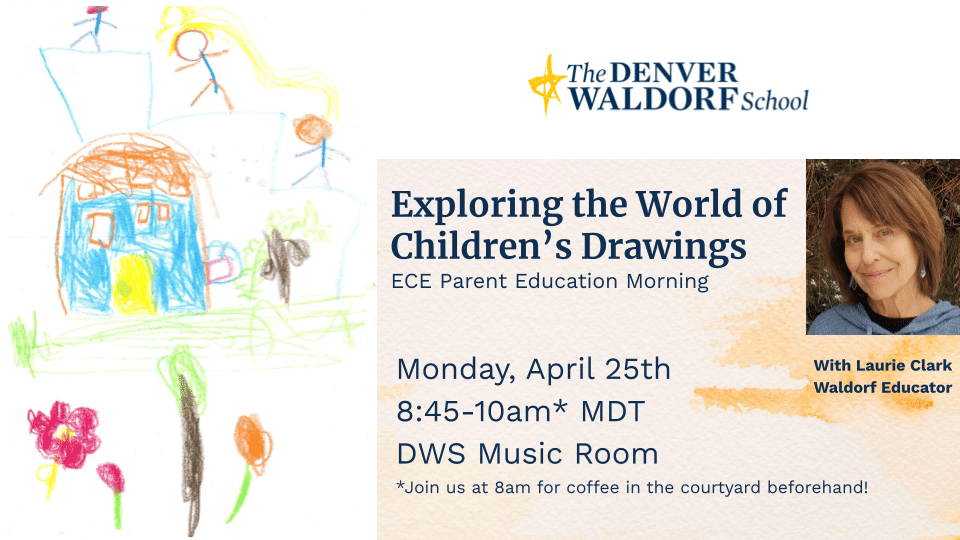
Exploring the World of Children's Drawings: Experiential Workshop with Laurie Clark
If These Walls Could Talk
What motivates your child to draw and why do they draw what they do? Join us for an experiential workshop led by long-time Waldorf educator and ECE expert Laurie Clark on how children’s art is a window into the wonder of their unfolding individuality.
Date: April 25, 2022
Time: Coffee from 8-8:45am; presentation from 8:45-10am
Location: Music Room
*We will gather in the courtyard at the front of the school for coffee before heading to the Music Room for the presentation. All are welcome to join!
What You’ll Learn
During the presentation, you’ll explore this phenomena and learn:
- How children’s drawings during their first 7 years are a map that help us understand their developmental stages
- How to “read” what your child is trying to reveal to you through their drawings
About ECE Waldorf Educator Laurie Clark
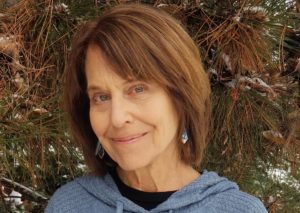 Laurie Clark has had the privilege of being a Waldorf early educator since 1978. She incorporates her therapeutic training into all aspects of the classroom and is in continual research through observation and constant engagement with the young child. The deep question of how to meet the children of today and exploring their needs in practical applications lies at the heart of her work. Laurie mentors teachers, is a frequent conference presenter, and has co-authored two books with Nancy Blanning on therapeutic movement for young children.
About The Denver Waldorf School
Founded in 1974 on Rudolf Steiner’s humanitarian curriculum, DWS believes education should foster what it is to be human, cultivate lifelong curiosity, and inspire a love for the world. Want to learn more about the benefits of Waldorf education? Join us online during one of our many virtual events.
DWS is also currently enrolling preschool, kindergarten, elementary, middle and high school students. Tour our school to see the Denver campus and meet us in person!
Register to Attend
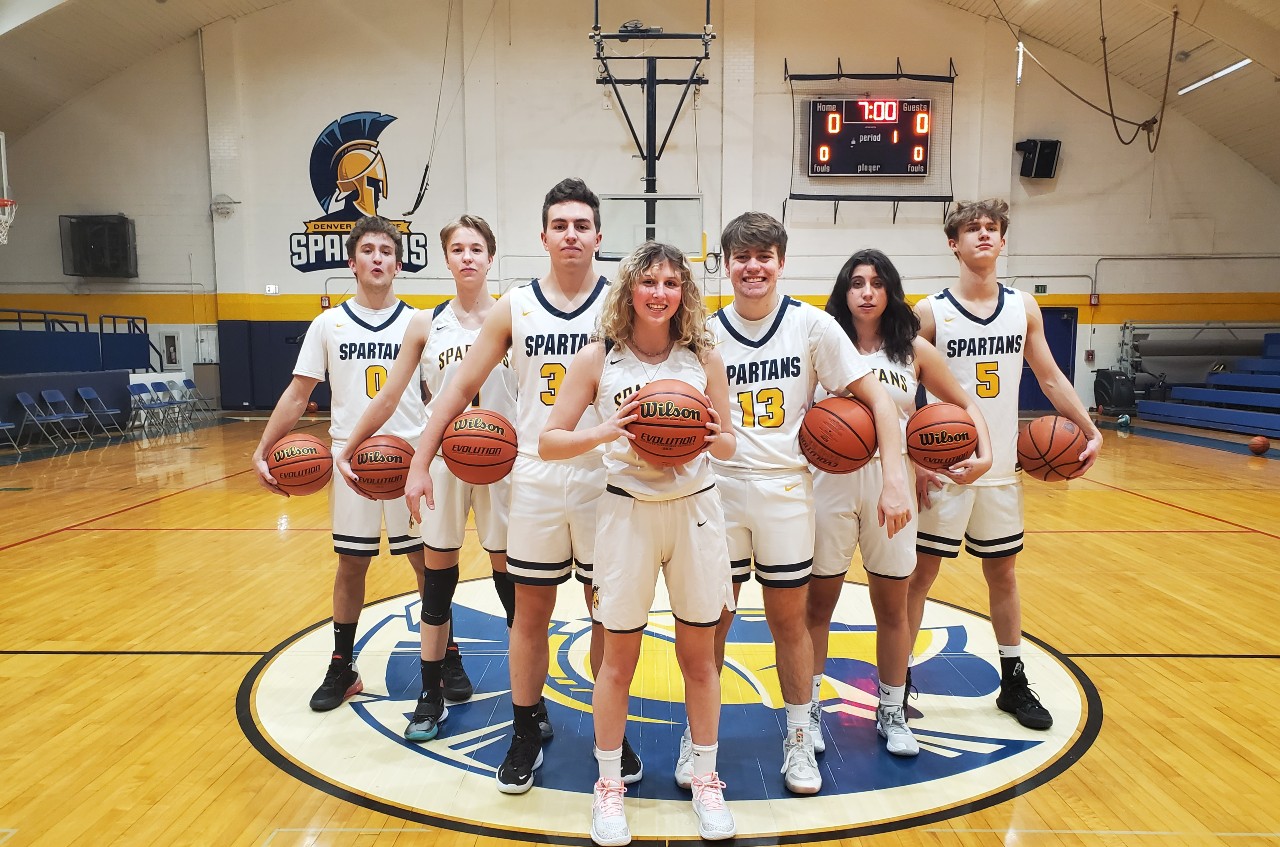
High School Spartans Sports Banquet
Celebrate our Spartans
The High School Sports Banquet is back! Athletes and their guests are invited to attend in celebration of such an incredible year of Spartan sports.
Date: Friday, April 29th
Time: 6-8pm
Location: DWS
Fee: $25* (students and their guests)
*Coaches are free.
Menu
This event is catered and advanced purchase of tickets is required. The menu includes:
Caprese Grilled Chicken – Basil Grilled Chicken, Tomato Basil Compote, Fresh Mozzarella and finished with a Balsamic Glaze (GF) Rice Pilaf (GF) Garlic Butter Haricot Vert (GF) Garden Salad with Ranch and Italian (GF) Rolls and Butter
Vegan/Vegetarian Option* – Burrito Stuffed Sweet Potatoes Baked Sweet Potato stuffed with rice, tomato basil compote (cheese for those non Vegan) and finished with a balsamic glaze. Topped with toasted pine nuts.
Dessert – Assorted Cookie Platter to include GF items
Drinks – Iced Tea, Lemonade
*Please indicate how many in your party prefer the vegetarian or vegan option.

Festival of Life Renewed
Join us outside for the Festival of Life Renewed. Sunshine, music, Maypole dancing, and more! Plus, Parent Council will be handing out goodies and sponsoring some fun eco-friendly activities.
Date: April 25th
Time: 3-4:30pm*
Location: Playground at The Denver Waldorf School
*We will maintain regular dismissal at 3:30pm, but families are welcomed to stay until 4:30pm.
School Day Service Projects
During the school day, students will participate in a number of service projects.
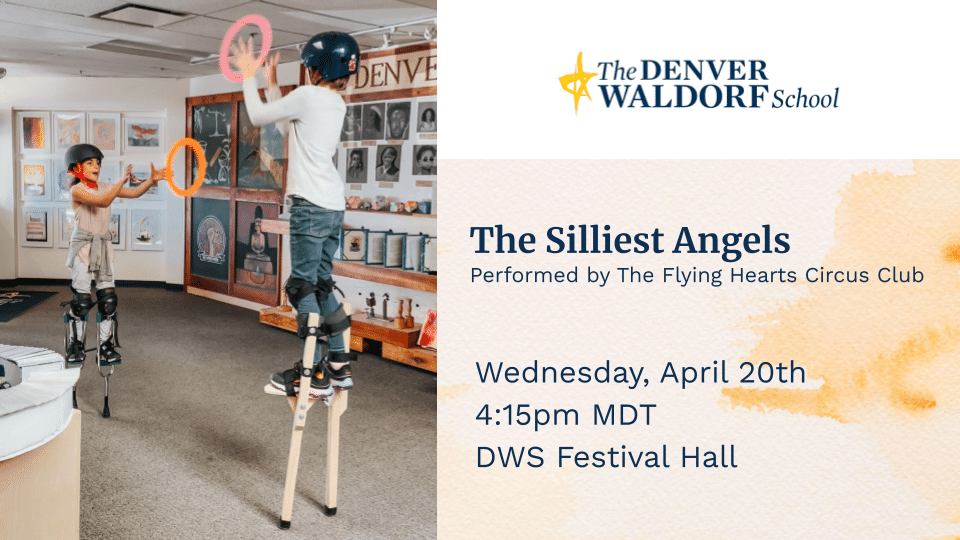
The Silliest Angels — A Performance by The Flying Hearts Circus Club
You are cordially invited to a performance by our afterschool circus program, The Flying Hearts Circus Club. We will be presenting a simple yet engaging show entitled The Silliest Angels. Students from grades 1-6 will show the skills they have been developing over the course of the last few months in this playful romp.
Date: April 20th
Time: 4:15pm
Location: Festival Hall at The Denver Waldorf School
All ages are welcome to see the wonders of hard work, focus, courage and silliness which is the circus.
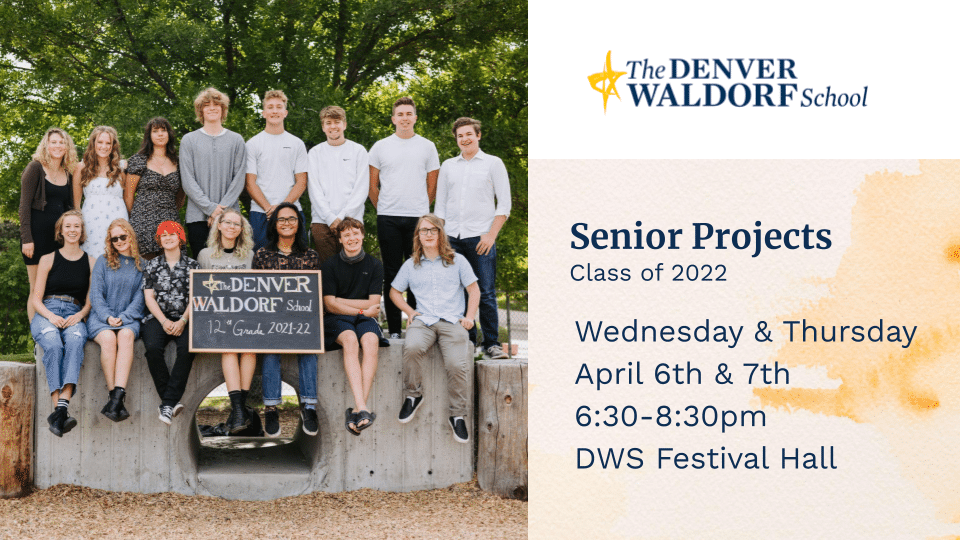
Senior Projects
A highlight of the senior year at a Waldorf School, the Senior Project culminates in an oral presentation before classmates, faculty, friends, and family. Join us in person for two incredible evenings!
Date: April 6th and April 7th
Time: 6:30-8:30pm
Location: Festival Hall at The Denver Waldorf School
Wednesday, April 6th
Stazi Salazar — The Way of a Doula
Dylan Quinn — Music Production
Liv Kuijper — The Lifeline Fund
Phoenix Ywanciow — Sola: A Project in World Building
James Stuart — Song Writing & Music Production
Elan Volk — Becoming an Online Entrepreneur
Daisy Macomber — Selfhood
Olivia Limburg — Constructing and Renting a Pull-Behind Trailer
Thursday, April 7th
Eliza Blanning — Documentary on Body Image & Social Media
Jonah Carr — Hello World
Guthrie Turner — Becoming an EMT
Lucas Lewis — Scrap Metal Welding
Naomi Noone — Songwriting Journey
Jasper Pastor — The Art of Tattooing
Asher DeMoney — Photography
Will McHenry — Model G
What are Senior Projects?
The senior year at a Waldorf school is designed to be a synthesis of the students’ education and a preparation for their next step in life. As twelfth graders stand on the edge of adulthood, they long for independence and yet are still unsure of their place in the world. The Senior Project is designed to help students begin to bridge this gap, preparing them for college studies and professional work in the world. Students must design a project that forces them to pursue a new area of interest or something that will stretch their abilities, mentally, physically and/or emotionally.
The individual projects are approved by the High School faculty and supported by an adult mentor who is an expert in the chosen field of endeavor and preferably someone outside of the familiar school community. The project scope is equivalent to one main lesson block, or about eighty hours of work, and typically extends over many months of the school year. The project culminates in a formal presentation of learning to the community.
Science in the Waldorf Curriculum
“How can I be the person who potentially takes this field forward?” That is the question that DWS high school physics and mathematics teacher, Adam Newman, wants his students to ponder.
This question arises from years of thoughtful scientific study, beginning in kindergarten and continuing through elementary school, middle school, and high school. A developmentally appropriate scientific curriculum — interwoven with history, arts, and mathematics — empowers our students to think critically, observe carefully, and find their place in a dynamic world.
The Scientific Journey from Kindergarten Through High School
Our education in science begins with our youngest in kindergarten. Quite simply, the children observe and experience the world in a way that develops foundational scientific skills.
In the early years, nature walks allow young children to hone their skills of observation. In the springtime, they may see tulips pushing through the soil and opening their beautiful colors to the sky. They may hear a mother robin chirping to her babies in the bough of a spruce tree. They may feel the soil, warm and soft underneath their little toes.
In addition to nature walks, kindergartners come to intuitively understand mechanical processes by simply playing on a teeter totter or kicking their legs out on a swing. During story time, they become engrossed in stories of nature, all the while building a foundation on which later scientific training will rest.
This foundation continues into the early grades. By third grade, students learn ecology by studying how people work in the world — in this case, how farmers serve as stewards of the earth. The youthful eagerness to work and to learn about the world spark an interest in natural processes.
In fourth grade, students directly study the living world through explorations of the human and animal kingdom. The students employ the arts to further their study of morphology. As long time DWS teacher Tom Clark says, “The arts are the good friends of science. Together, they help us understand reality.” The study of morphology encourages students to perceive reality through truth and observation.
In the last year of elementary school, fifth graders study the living world through botany. They carefully draw plants, further training their powers of observation. To truly understand a natural system, one must first be able to observe and reproduce its critical elements.
In middle school, the science curriculum is tailored to the students’ awakening intellects through the study of chemistry, physics, and physiology. They learn experientially through their senses. The principle theme, as Mr. Clark explains, is: “without jumping to a conclusion, what exactly did you see?” From experiment to concept, students learn through hands-on experience and carefully record their observations.
In seventh grade, the students explore mechanics, learning how simple machines work. They work with levers to grasp how a relatively small amount of force can be applied to lift, for example, the back end of a teacher’s car!
With this solid understanding of basic machinery, eighth graders are challenged to understand the technology that impacts our lives. From stereo headphones to motors to internal combustion and jet engines, our Waldorf students gain a working knowledge of the forces at work in our modern world.
By the time a Waldorf student enters high school, they have already developed keen powers of observation. The focus in high school centers around the capacity to think scientifically across various disciplines — including chemistry, biology, and physics.
Unlike some high schools that may teach biology one year and chemistry the next, DWS integrates the major scientific disciplines into each of the four years through their block system. Consequently, our graduates will have taken chemistry, for example, in all four years—not just one.
In ninth grade, students are “very much into the what” of the world, as explained by Nancy Taylor, DWS high school science teacher for the Life Sciences (biology and chemistry). The study of anatomy taps into this natural curiosity during the ninth grade year.
In tenth grade, students crave a more dynamic type of thinking. DWS challenges its students to move from a static to dynamic view of the world through the study of physiology — focusing on the flow of how bodily systems work.
Eleventh grade marks a continued shift to the powers of abstract thinking. In chemistry, that means a study of the atom as a unit of matter. In biology, the focus moves to the cellular level.
From atomic chemistry to embryology to immunology, the students engage their intellect in abstract ways. This intellectual shift to the abstract is made possible by all of the foundational capacities developed in prior years, including attention to detail and acute observational skills.
The big question for twelfth grade is: “how do I fit into the world?” This question naturally lends itself to a study of zoology, the human being, and biochemistry. And to think it all began with those simple nature walks in kindergarten!
Teaching Science to Prepare Productive Citizens of the World
Science is a dynamic universal language that develops the capacity to observe, to think, to be open, to learn from history, to be flexible, and to problem-solve thoughtfully. These skills are crucial as DWS graduates enter a world marked by challenges and opportunities.
Consequently, science in our Waldorf curriculum is not just a specialty subject reserved for a few; rather, all students undergo rigorous scientific development during their time here. Dr. Taylor’s biochemistry course in twelfth grade is the culmination of a four-year journey in chemistry with each and every high school student.
In the words of Mr. Newman, each student must give science a “proper go” and cannot “tap out” when the scientific rigor intensifies. He believes in giving each student the chance to fall in love with science. Dr. Taylor fully agrees that “they can all do it,” and that each student is capable of developing an “intuitive sense of how the world works.”
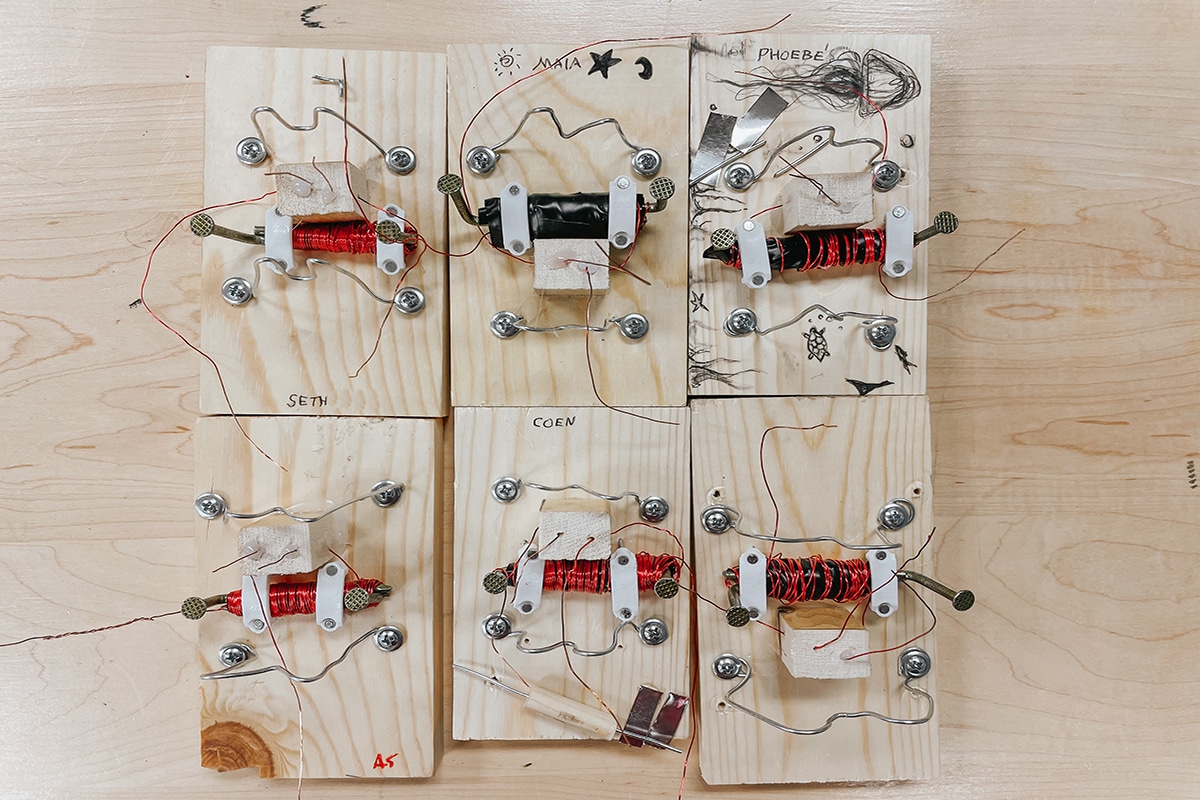
To achieve this foundation, DWS teachers encourage their students to think of themselves as part of an ongoing scientific mission to understand the world. In the study of electromagnetism in high school, for example, the class begins its study with the history of the thinking about electromagnetism.
While it may be tempting to just jump to the current model of electromagnetism, Mr. Newman pushes his students to follow and replicate the early experiments that led to our modern day understanding of the subject. The students live the scientific method, setting up experiments, observing the results, and understanding how our collective thinking in a subject evolves with each developmental step.
Our students are not just told what’s going to happen. They must conduct the experiments in electromagnetism and observe the results themselves. By embracing this process, the students understand the historical trajectory of a particular field of study and, importantly, its future direction.
DWS graduates enter the broader world with a well-developed ability to observe, to be flexible, to problem-solve, to predict and test, and to think critically with an open mind. Whether a graduate continues with the study of science in college and beyond, or pursues another field entirely, these skills will serve them and humanity well.
To listen to our teachers share about the curriculum, take a listen to our podcast covering this topic here.

Variety Show
DWS Variety Show Returns to the Stage
All families, alumni, and friends are invited to join us in the Festival Hall for a celebration of DWS talent! Hosted by High School students David Neves and Hannah Witkoff alongside Development Officer Hannah Ronan-Daniell, this event showcases acts of all ages.
Date: Wednesday, April 27th
Time: 6pm*
Location: DWS Festival Hall
*Prior to the event, Parent Council is organizing a potato/chili dinner on the playground from 4:45-5:45pm. Stay tuned for communication from PC class reps on how to contribute to this potluck!
Submit Audition Videos by April 15th
Getting your act together? In lieu of in-person auditions, we are currently taking audition video submissions via email for the Variety Show through April 15th. Videos should run no longer than four minutes.
Front Row Tickets and Event Sponsorship
Want to ensure you are at the front of the crowd at the DWS Variety Show? Reserve one of our 22 “Front Row Gnome” tickets for $50 each – All proceeds support the DWS Scholarship Fund, creating equity and access to education for our students each year.
Interested in sponsoring this event? Our $800 sponsorship package includes 2 “Front Row Gnome” tickets, promotion on our Instagram, a logo on our Giving page until the end of August this year, and a public, verbal promotion during the Variety Show event. Again, this package supports our needs and merit-based DWS Scholarships!
To purchase a Front Row Gnome Ticket or Sponsor this event, reach out to Development Officer Hannah Ronan-Daniell: [email protected] or 303.777.0531 ext. 107
About The Denver Waldorf School
The Denver Waldorf School is an urban pre-K through 12 independent school in Colorado. Founded in 1974 on Rudolf Steiner’s humanitarian curriculum, DWS believes education should foster what it is to be human, cultivate lifelong curiosity, and inspire a love for the world. We are currently enrolling for in-person learning:
Want to learn more about us? Learn more about our in-person and virtual events, read our blog, or take a listen to our podcast.
Submit Your Audition Video by April 15th
Please email audition videos (4-minute max) to Vernon Dewey with the subject line “Variety Show Submission” by mid-April.
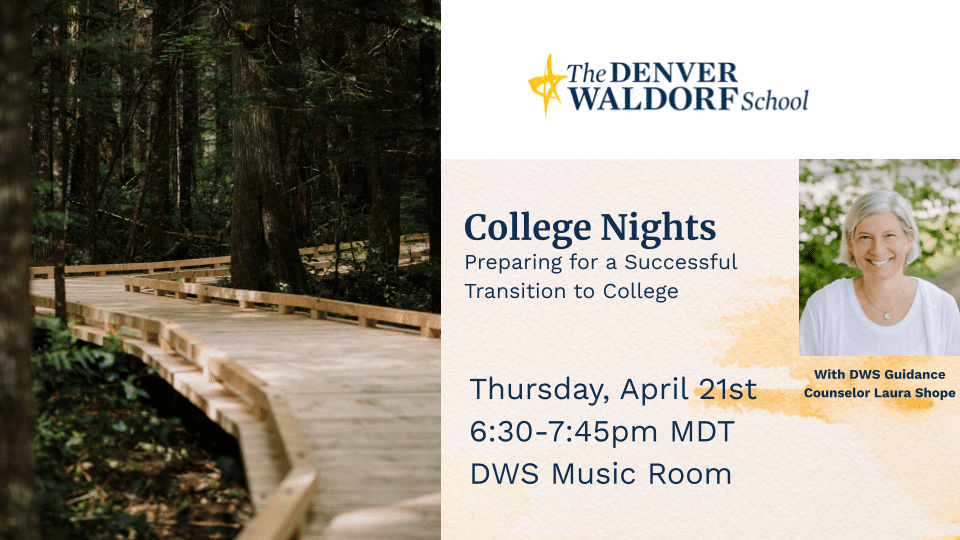
College Nights: College Engagement and Success
How to Prepare for a Successful Transition to College
Parents and students are invited to attend the April session of our monthly College Nights series with DWS College and Post-Secondary Guidance Counselor Laura Shope.
Topic: College Engagement and Success — Ideal for 12th Grade
Date: April 21st, 2022
Time: 6:30pm
Location: In person at DWS
Please register once to reserve a seat for all remaining dates.
What You’ll Learn
This evening is tailor-made for our senior class families (and everyone is welcome to hear a preview!). We will be discussing how to prepare your student for a successful transition from high school to the college environment. We will identify skills your student should have in place before school starts, tools, and resources to support their transition to campus/classes, as well as how to take care of yourselves as parents in this significant time of life.
Key takeaways include:
- Perspective of the changes students will encounter between high school and college
- Tools and resources to support your student before, during and after arriving on campus
- Next steps for your family to prepare
About College Nights
Our monthly College Nights series focuses on different aspects of the college and post-secondary application process. Laura Shope designed each evening to answer questions and support parents and students in the college application process. These meetings are open to all, although probably most useful to the grade listed with each topic.
- October 7th—Application Process 101 (Grades 10 and 11)
- November 4—SAT and ACT (Grades 10 and 11)
- December—No meeting
- January 6—Supporting Your Student through the Process (Grades 10 and 11)
- February 3—Paying for College (Grades 10 , 11, and 12)
- March 3—Making Choices (Grades 10 and 11)
- April 21—College Engagement and Success (Grade 12)
- May 4—Preparing to Apply & Making the Most of Summer (Grade 11)
About Laura Shope
Laura Shope came to DWS in 2021 via the Rudolf Steiner School of Ann Arbor, where she served as the High School Student Support Coordinator and High School Administrator for the past three years, and a parent in the Waldorf community for more than 17 years. She has extensive training in career development and personal coaching, along with having recently completed her Waldorf High School Teacher Training through the Center for Anthroposophy. Her plans for working with our students and faculty include creating a rich program of self-reflection, support, and clarity around the decisions the students make for their plans after high school.
Laura is a passionate artist and works with stone, clay, wood, weaving, and plaster to create abstract forms. She and her husband, Dale Jensen, are outdoor enthusiasts and look forward to exploring all that Colorado has to offer. They have two sons, Wilder and Corbin, who attended Waldorf schools from preschool through grade 12 (Corbin will graduate from RSSAA in 2022).
About The Denver Waldorf High School
The Denver Waldorf High School offers a liberal arts education, consciously aimed to nurture and encourage adolescent ideals. The high school experience aims to balance the students’ academic needs with their longing to find meaning in the world. Scroll down to hear from a few of our faculty members.
Engaging Body, Intellect, and Emotion
At the start of each day, movement helps spark students’ circulation and bring them together. They then engage in a long, uninterrupted seminar (referred to as main lesson in elementary and middle school) to activate their minds, followed by music and elective classes to spark emotional expression. Music classes and elective courses promote the development of healthy emotional expression through creation.
High School Music
Regarding music, all high school students participate in chorus, with the option to participate in either music ensemble or orchestra until their senior year. Students new to DWS and who have not played their instrument before are strongly encouraged to take private lessons.
Hands-On Learning of Real-World Skills
Students apply what they’ve learned theoretically to scenarios in the real world. For example, a study of soil composition could be applied to a chemistry lesson on acids and bases, as well as a close reading of The Grapes of Wrath, and a course in black-and-white photography in which they learn to develop their own film.
Rhythm of Thinking, Feeling, and Willing
Our goal is to expose our high school students to academic wealth, and demonstrate to them that all knowledge is valuable to encourage their pursuit of wisdom throughout life.
The high school curriculum revisits themes and subjects periodically to strengthen functional knowledge. Students cultivate their ability to think critically, organize ideas and information, and clearly present thoughts through an academically challenging mix of math, English, humanities, physics, life sciences, chemistry, world language, practical, industrial and fine arts, chorus, orchestra, drama, and physical education.
About The Denver Waldorf School
The Denver Waldorf School is an urban pre-K through 12 independent school in Colorado. Founded in 1974 on Rudolf Steiner’s humanitarian curriculum, DWS believes education should foster what it is to be human, cultivate lifelong curiosity, and inspire a love for the world. We are currently enrolling for in-person learning:
Want to learn more about us? Schedule an in-person tour of our Denver campus or join us online during our virtual events.
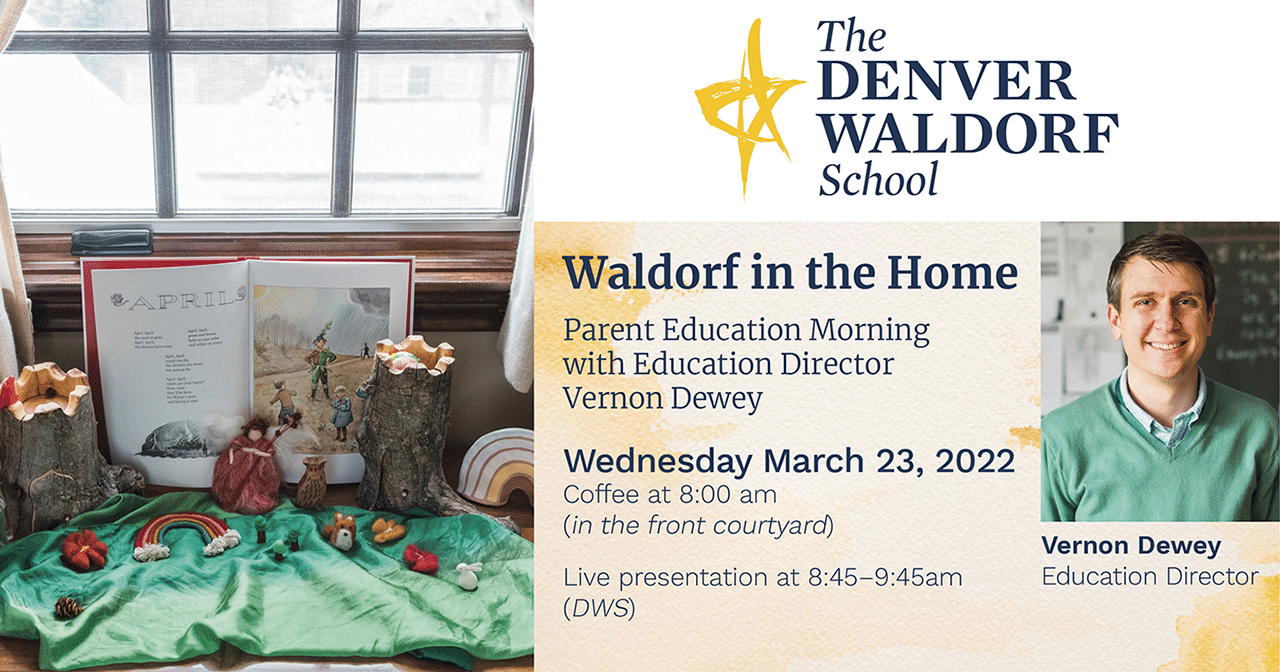
Waldorf in the Home
Parent Education Morning with Education Director Vernon Dewey
Join us for an in-person presentation led by Education Director Vernon Dewey on how Waldorf pedagogy can support our parenting. In this talk, he will explore “Boundaries as Breathing: Using Rhythm as Preventative Discipline.”
Date: Wednesday, March 23rd
Time: 8:45-9:45am*
Location: DWS
Please register to reserve a spot.
*Prior to the presentation, all are invited to join us for a cup of coffee in the courtyard at the front entrance of the school. We will start pouring at 8am!
About The Denver Waldorf School
The Denver Waldorf School is an urban pre-K through 12 independent school in Colorado. Founded in 1974 on Rudolf Steiner’s humanitarian curriculum, DWS believes education should foster what it is to be human, cultivate lifelong curiosity, and inspire a love for the world. We are currently enrolling for in-person learning:
Want to learn more about us? Learn more about our in-person and virtual events, read our blog, or take a listen to our podcast.