
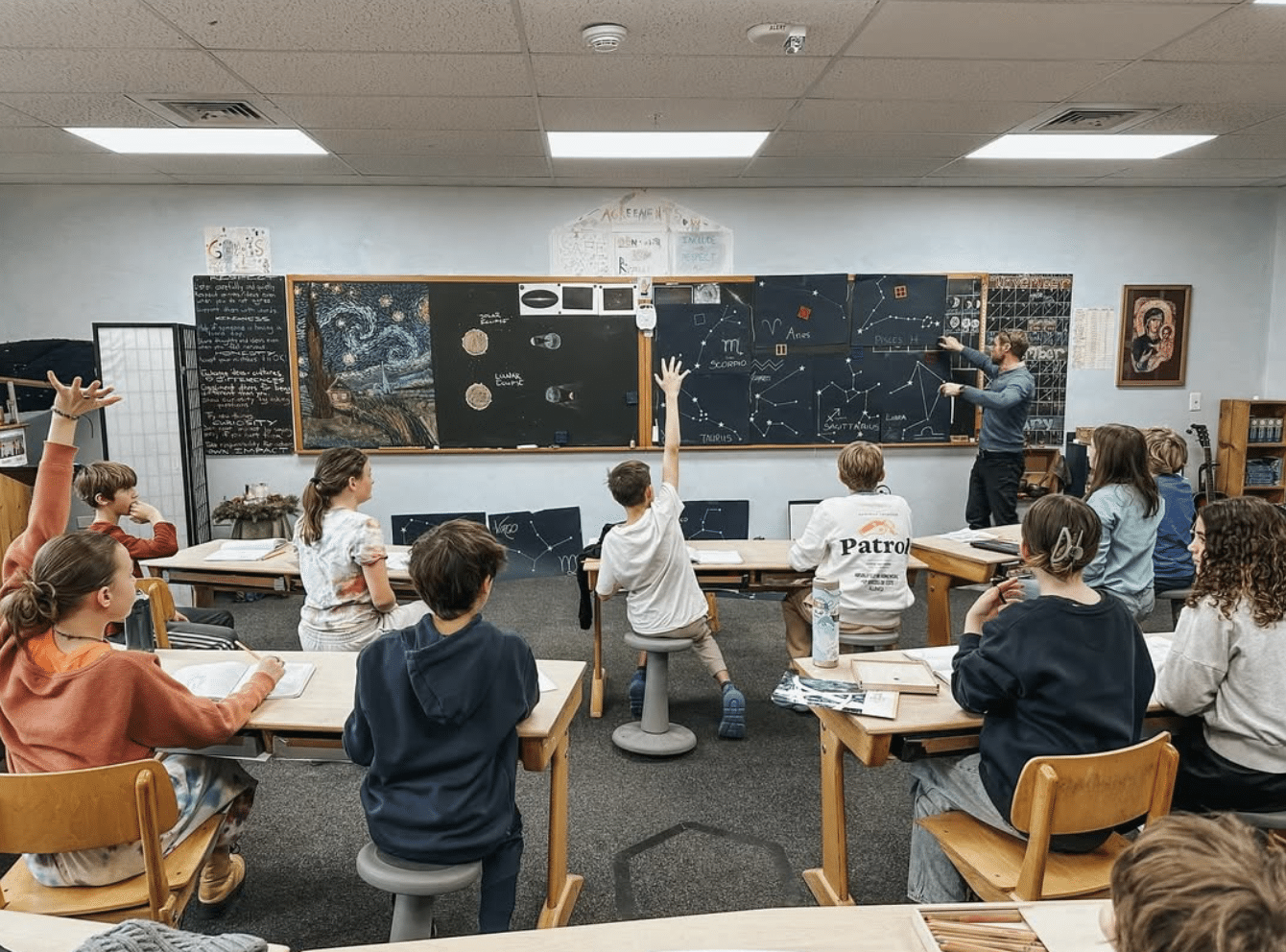
What's Up With Looping in Waldorf?
When The New York Times published research showing that teacher looping improves academic achievement and classroom outcomes, Waldorf educators responded with a resounding “well, yeah- of course!” For more than a century, Waldorf schools have practiced looping- not as a trend, but as a foundational principle of relationship-based education.
At first glance, the word “looping” might sound like a ride at Lakeside Amusement Park or a technique your child learns in Handwork class. In education, however, it refers to a teacher staying with the same group of students as they move from grade to grade. Although looping has gained media attention in recent years as schools look for ways to strengthen student connection and presence in the classroom, Waldorf schools have practiced it for more than 100 years. In some schools a teacher may stay with a class for lower grades (1-4) or middle school (5-8), while in others the journey lasts all the way through eighth grade- until the students are ready to learn from and alongside our high school educators who are experts in their respective fields.
The idea of a teacher staying with a class over a number of years was brought by Rudolf Steiner in the first Waldorf school in Stuttgart, Germany, in 1919. This practice is deeply rooted in Steiner’s philosophy, which emphasized that teachers should remain with children as long as possible, especially during the formative years between ages 7 and 14. At the heart of this idea is the belief that the most powerful educational tool is not a textbook or a test- it’s the relationship between teacher and student.
Research supports what Waldorf educators have practiced for decades: strong relationships foster stronger learning. Education is inherently adventurous- students are constantly trying new skills and stretching beyond their comfort zones. A trusted teacher provides the safe and grounding space that encourages children to take those leaps..
Traditional education often positions teachers as “content specialists”- an expert on the stage imparting knowledge- a one-way, lecture-based style. Waldorf education flips that model. Each student arrives with knowledge and curiosity, and learning happens in the collaborative space between teacher and student. Teachers are not just lecturers- they are representatives of the world, meeting students with relevant subject matter at each stage of development.
Parents often wonder how looping prepares children for high school. Some assume Waldorf’s relationship-based approach is ideal for the early grades, but worry that students need a more main stream education once they reach high school age. In reality, looping equips students with a cultivated expectation for learning through authentic relationship. By the time they reach high school, Waldorf students carry a strong sense of curiosity they can trust will be satisfied and an insistence on genuine engagement. They are not satisfied with surface-level teaching; they want teachers who are both experts in the subjects and deeply invested in who they are, in and outside of the classrooms. This expectation, that teachers understand how to bring materials to each individual learning style and the contexts that affect a students ability to lean, is part of what makes Waldorf high schools so unique.
Looping also impacts the class as a whole. Staying together year after year fosters a family-like community, with all the joys and struggles that come with it. Conflict is natural, but Waldorf schools place a strong emphasis on restorative practices and conflict resolution ensuring that children (and parents) feel supported as new families join or dynamics shift.
Of course, looping raises questions. What if a student and teacher don’t get along? What if a teacher is struggling in their class? Waldorf schools address this with intentional structures: ongoing professional development, mentorship, and honest conversations. Sometimes a teacher and class may part ways, but more often the relationship itself becomes the catalyst for growth- for both teacher and student.
The results are clear: looping works. It strengthens bonds and deepens learning, preparing students not only for academic success but for life as resilient team players.
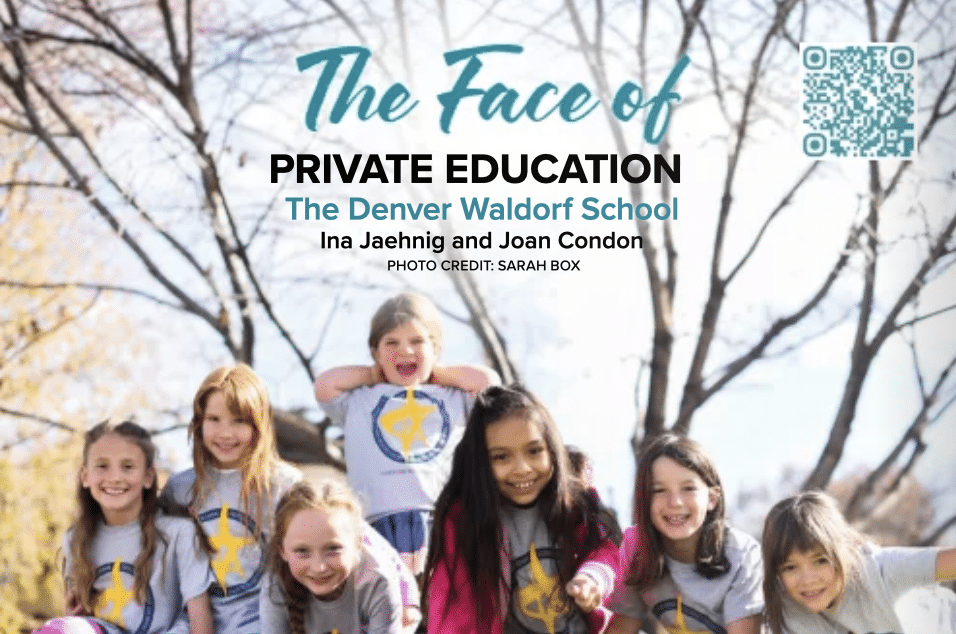
Honored as Denver’s Face of Private Education
We’re BEYOND honored to be featured as THE "Face of Private Education” in Denver by Faces & Places 2026- a beautiful celebration of the people and institutions shaping our community.
Being included along-side these industry leaders is a testament to the standout work we do every day in education. This recognition fuels our mission to create an educational experience that is not only academically strong, but deeply connected to creativity, community, and humanity. A heartfelt thank you to Faces & Places for this honour and to our entire school community- our teachers, administrators, students, families, and supporters- for making this possible.
Read Our Article:
Founded in 1974 as Colorado’s first Waldorf school, The Denver Waldorf School provides a Pre-K–12 education rooted in both tradition and forward-thinking pedagogy. Located in the heart of the city, DWS offers the rare combination of an urban campus with frequent access to nature—just steps from the 80 acres of fields, trees, and trails at Harvard Gulch Park. This blend allows students to learn in ways that engage both head and hands, whether studying earth science outdoors, composing and illustrating their own textbooks, or exploring literature through performance. Here, the world becomes their classroom, inviting students to observe, perceive, and connect more deeply with their environment.
At DWS, learning is alive. A holistic, arts-integrated curriculum nurtures intellectual curiosity while supporting emotional attunement and confidence. Movement, play, and experiential learning are foundational. Relationship-based teaching is strengthened through looping, where faculty progress with students over multiple years—deepening understanding, trust, and individualized support.
Kindergarteners learn through play, storytelling, and hands-on activities like baking and foraging as a group. In first grade, every child begins handwork through knitting—an exercise in patience, dexterity, and creativity. By eighth grade, students have practiced sewing, embroidery, and other practical crafts that build capability and artistry. All students engage in music, theater, and traditional STEM studies from kindergarten through twelfth grade, endowing them with a well-rounded sense of what it means to be fully human in the world.
We take the humanities literally. Our students are renaissance thinkers from the moment they arrive. And as Spartans—our mascot in spirit as well as athletics—they practice a robust range of subjects, developing resilience through challenge and versatility of skills. They learn not just information, but how to learn: how to observe, perceive, communicate, and navigate the world with clarity and empathy. These human capacities are increasingly essential in an automated age. With a 100% college acceptance rate, DWS graduates emerge as collaborative teammates, thoughtful innovators, and compassionate leaders.
A key principle of our philosophy is cultivating original thought by minimizing digital distraction in formative years. With a mindful, age-appropriate media and technology policy, students first build imagination, focus, and the capacity to reach their own conclusions by engaging with the depths and layers of the world—later pairing these strengths with technology from a grounded perspective.
More than ever, students need an education that fosters resilience, adaptability, compassion, and confidence. They need the intentional integration of academics, arts, music, and movement to educate the whole human. Welcome to The Denver Waldorf School.
The Light Within and With That We Share
It's the second Monday morning in December, which means the school will be gathering shortly in the Festival Hall for it's second Festival of Light Emerging assembly of the year. It is one of several holdings the students have a this time of year that allow them to live into the impusles that accompany the darkening days.
There is a busyness that’s easy to get enveloped in this time of year as parents and caregivers — a busyness driven by the desire to create joy for our loved ones and express our deepest gratitude. We can become swept up in the pressure to get it all 'right,' turning this busyness into overwhelm and making it difficult to find our own joy, which can feel elusive or lost altogether.
For our children, within these walls, things look quite different. This time of year is honored through a deepening practice of slowing down, quiet observation and reflection, and inward exploration. The darkening days provide the perfect canvas to journey inward, connect with the light that resides within, and bring it forward to illuminate the way for others. In this expression, we just might recognize the light in another as one we all share. This exploration of light begins with the Lantern Walk in the fall and continues through the Festival of Light Emerging, the Winter Spiral, and Santa Lucia.
Monday mornings in December begin with an all-school assembly honoring the Festival of Light Emerging. Our students join in a dimly lit Festival Hall where they are met with a familiar sequence of greetings, song, story, verse, and candle lighting — all wrapped in a dependable cloak of reverence. One student from each grade is tapped prior to the assembly to light a candle for their class. Starting with 12th and ending with 1st, they come to the stage one by one to light their candle from the same flame. This light then travels back to their classroom by way of their teacher, students following close behind.
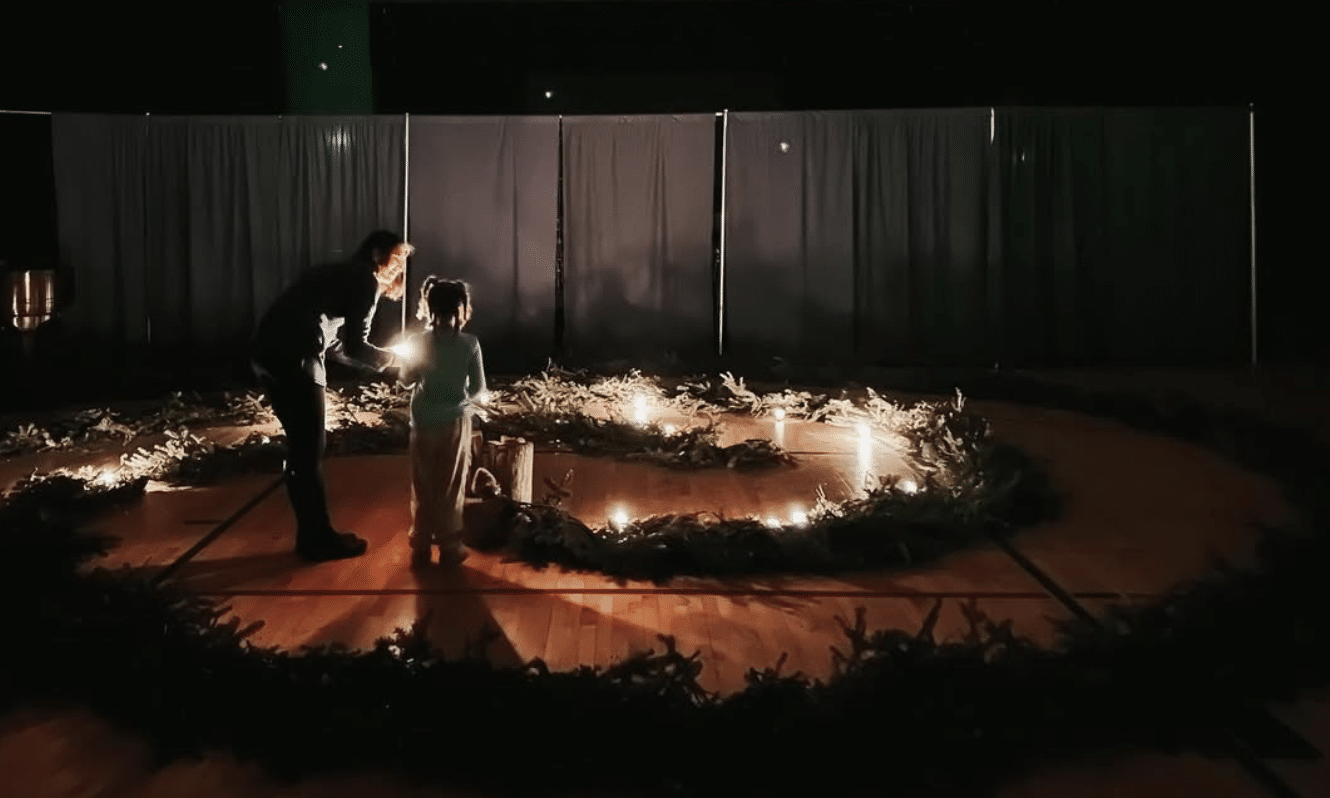
This week, our students will walk the Winter Spiral. A pathway outlined in evergreens will form a spiral leading to a single candle lit at the center. Students will follow the spiral, unlit candle in hand, until they reach the light at the center, which they’ll use to light their own. On their path out — different from the one taken in — they will choose a place to set their now-lit candle, illuminating the way for those who follow. Although the spiral of carefully laid evergreens may appear unchanged, each individual’s journey within it will be distinctly different— inherently their own.
This Friday, each classroom will be visited by second graders, singing proudly and adorned in white tunics and handmade crowns. They'll bring Santa Lucia buns to share, a symbol of light and hope. They’ll carry a mood of reverence, extending a gesture of generosity, and be met with gratitude.
These are experiences aligned with the rhythm of the natural world, which call us to pause, to embrace the quiet moments, and to hold space for the light we carry within and the light we see in others. For our children, their education includes a foundation in the lifelong practice of journeying inward and an intrinsic desire to share their discoveries with others.
It makes me wonder for us as adults - in our busyness to share light with others, are we bypassing our journey inward? If so, what is it that we are truly sharing?
Unfolding these experiences, both within the school and within our homes, is not without effort. Maybe more so at this time of year, it can be difficult to decipher meaningful effort from the simple busyness that fills our days. A question to consider might be if our efforts are drawing us toward connection within ourselves and with one another or pulling us away. While everyone's journey is uniquely theirs to know, we can be respectful observers and provide one another grace for what cannot be seen. In the end, it's not doing it 'right' that brings us closer, but rather how we feel when we are together.
In this shared space of reflection and grace, we create a community that is deeply rooted in presence and understanding. May we continue to walk this path together, embracing the beauty of the season and the peace that comes when we allow ourselves to be led by its natural rhythm.
Shared with us by Alexandra Wheatlake, Community Liaison

How Waldorf Students Learn Without Textbooks
The absence of textbooks in Waldorf schools is often one of the first differences new families notice. To some, it feels unusual- even unsettling. But in truth, it reflects one of the deepest commitments of Waldorf education: that learning should be alive, creative, and rooted in the will of the student.
Instead of relying on pre-packaged content, Waldorf students create “main lesson books”- handmade records of their learning that combine writing, art, and reflection of the material brought to them throughout each 4 week block. These books are not mere assignments; they are acts of will. Each page requires the student to digest information, internalize it deeply, and then transform it into something meaningful. In this way, students aren’t just studying historical dates, authors names, or scientific formulas- they are carefully curating knowledge through their own effort.
The role of the teacher is equally transformative. Without a textbook to pull information from, Waldorf teachers fully immerse themselves in their subject. Lessons are not recited from a script, but woven together from diverse and creative sources- books, nature, field trips – their own lived experience and accounts of those that came before. This keeps content flexible and responsive to the times, allowing teachers to remain deeply relevant in a fast-changing world. To this effect, an artistic rendering of history may often be closer to truth than a standardized account in a textbook. Parents are often surprised at how rich these books become, not just in content but in the artistry and thoughtfulness behind them.
The implications for subjects like science and math are profound. Physics lessons, for example, begin with phenomena- a flame in a darkened room, a lever lifting a car- before moving toward concepts and theories. In math, students work through problems as living puzzles rather than rote drills, building confidence as well as understanding. This experiential, phenomena-first approach ensures that knowledge arises from observation and thought, not mere memorization.
Of course, the absence of textbooks does not mean the absence of rigor or thorough understanding. Waldorf teachers map their work carefully to state standards, ensuring that students are up to appropriate standards fully prepared for college admittance. In many cases, the curriculum goes beyond what is required, offering a richer and more integrated experience than traditional models.
To rely on a textbook is to accept a single lens on the world- one that is often shaped by politics or cultural bias. To teach without one is to embrace freedom, responsibility, and creativity. In doing so, Waldorf educators cultivate not only knowledgeable students but also independent thinkers who can meet the future with clarity and will.
'Tis the Season of Michaelmas
This week we celebrated Michaelmas — and with it, we welcome a new season.
In Waldorf education, we honor the turning of the seasons through festivals. These are more than celebrations — they turn our regard toward the rhythms of the Earth and offer an invitation to recalibrate, to harmonize with it.
At this time of year, within the walls of the school, glances of dismay are often exchanged at the entanglement and unfolding of circumstances. Inevitably, someone speaks “Michaelmas” into the space, and expressions soften — followed by a knowing, collective nod.
Michaelmas marks the beginning of the inward exploration that will continue through the winter months. This journey begins with uncovering the courage that lies within, so that we may face what lies ahead.
Michaelmas often appears as a series of calamities — false starts, a mirage of finish lines, unusual and unpredictable errors, and a gradual collapse of the confidences we claimed over the summer.
This is the work of ‘dragons’ — in full force — challenging us with great precision.
There is wisdom in their timing — rising as daylight shrinks, as darkness gains its foothold, and as the cool air draws us indoors. It is in the darkness — in our separation from one another and from the Earth — that they grow.
While no one can fight our dragons for us, or even often alongside us, others can help lift the shadows they cast. It is light that loosens their grip. When we allow others the honor of witnessing our battles, of witnessing our courage, we illuminate what was once murky, overwhelming, and isolating — not just within ourselves, but within those who witness us.
Are all dragons of this world external forces that we are called upon to vanquish? Or do some dragons serve as mirrors — revealing what lies within — asking not to be slain, but understood, worked with, tamed, even harnessed?
Though the days grow shorter, we are not without light. Though we travel inward, we are not retreating. This season primes us to find new sources of light and of strength — in ourselves, in each other, in our shared stories, and in the quiet resilience that rises when we walk together.
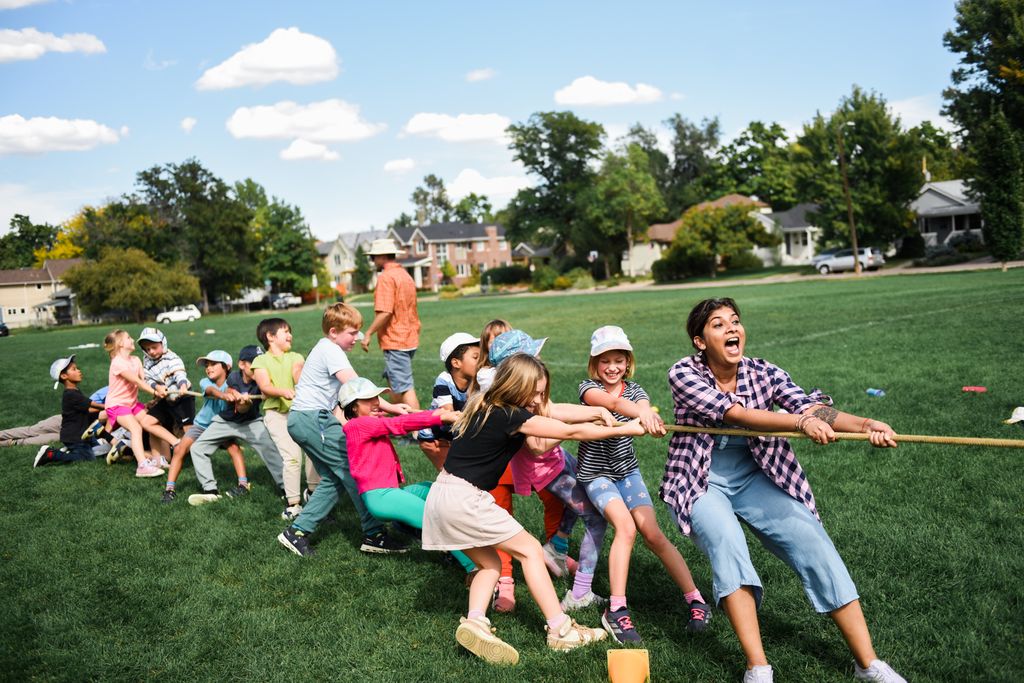
For our grades students, Michaelmas is songs, stories, verses, and poems of Michael and a Field Day filled with games that ignite their forces of will. For our High Schoolers, it is making ‘Fire Cider’ in cooking class, holding the Field Day games for our grades students, and for one lucky senior – playing the role of Michael cloaked in red and gold and wielding a sword of meteoric iron (cardboard)!
To support you in your journey and give you a window into your students’ lives at the school:
- Morning Singing - Michaelmas
- A guide to making Fire Cider
- The Reel composed by Sarah Box of Field Day
"Brave and true I will be.
Each good deed sets me free.
Each kind word makes me strong.
I will fight for the right, I will conquer the wrong"
Grateful to have this community to be brave with.