
Our lineup of online events are open to all, as we aim to highlight the benefits of Waldorf education. For more on all happenings at The Denver Waldorf School, please refer to our school calendar.

Loading Events

« All Events

  • This event has passed.

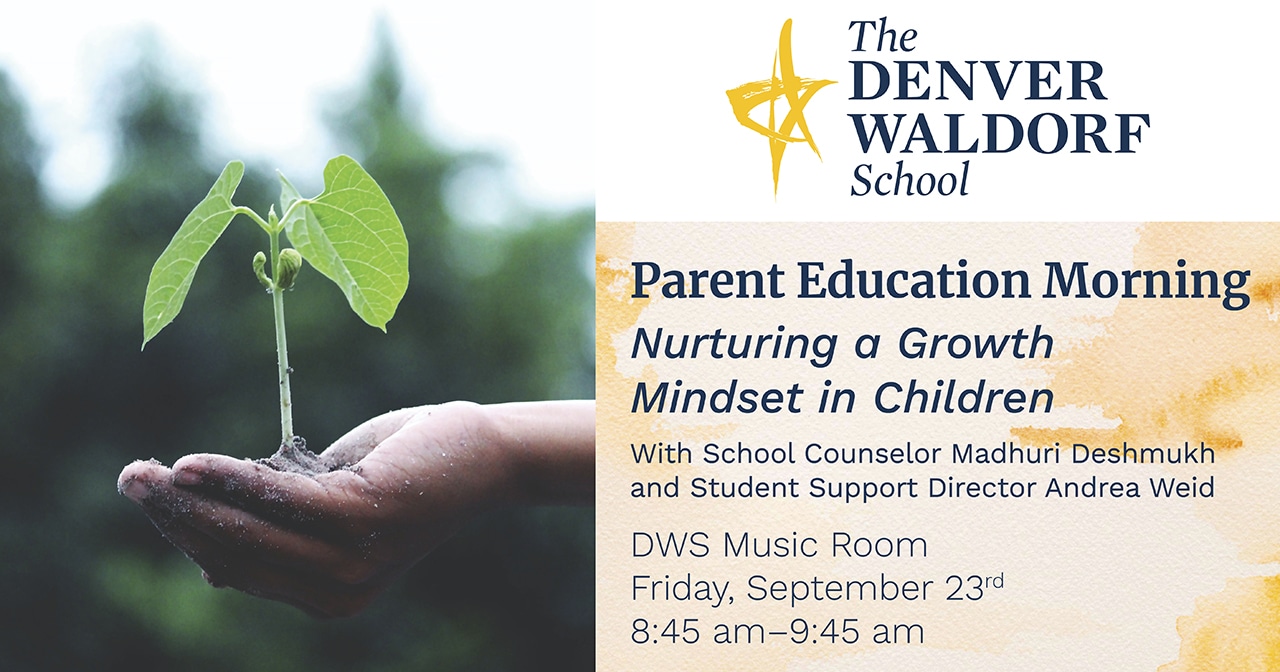
Parent Education: Nurturing a Growth Mindset in Children

September 23, 2022 @ 8:45 am - 9:45 am
Denver Waldorf School Parent Education Growth Mindset

How to Shift from Fixed Mindset to Growth Mindset

Are there areas in your child’s life where they are not motivated or inspired, give up easily, stay away from challenges, want to be perfect, and sometimes even lie about their performance? For some of our children, it might be music; for others, it might be academics or sports or having to talk to peers in school or on the playground. If so, those are areas where a child has a fixed mindset. Join us for a presentation led by Denver Waldorf School Counselor Madhuri Deshmukh and Student Support Direct Andrea Weid on shifting from fixed mindset to growth mindset.

Date: Friday, September 23rd, 2022

Time: 8:45-9:45am; Join us for Coffee in the Courtyard starting at 8am

Location: DWS Music Room

Please note childcare is not provided.

What You’ll Learn

This workshop focuses on understanding a growth mindset and how we can teach our kids to accept mistakes, encounter challenges, and problem-solve.  Specifically, you’ll learn:

  • The five core needs of children and teens as they grow toward healthy sexual maturity, and the five corresponding nurturing roles for families and school
  • The misplaced anxieties that keep adults from recognizing what is truly age-appropriate for kids to know
  • How to look behind children’s eyes, see what they see, and discover what they’re really wondering about
  • How to reduce discomfort and embarrassment—your own and your child’s
  • Research that demonstrates how vital early and ongoing conversations about sexuality are to health and well beings
  • Creating authentic partnerships between families and schools around sexuality education

What is Growth Mindset

The growth mindset is a theory invented by Stanford professor Carol Dweck, Ph.D., in early 2000. It is a belief that we can learn and develop abilities. People with a growth mindset recognize the value of accepting challenges and learning from mistakes. They see that despite their natural ability, they can improve their skills with effort and perseverance. On the contrary, people with a fixed mindset believe that you are either born with talent/abilities or not, and nothing can alter it; you cannot develop or enhance abilities. A child with a fixed mindset often thinks they cannot be successful because they are not good at something. For example; Fixed mindset: “I am not good at numbers, so I will never learn my math facts!” vs. Growth mindset:  “If I practice every night for 20 minutes, I will learn my multiplication facts!”

Firstly, we all need to celebrate mistakes. When children make mistakes, it is essential to help them see it as an opportunity for Growth. Remember, it is not uncommon for all of us to have a fixed mindset about some areas of our lives and a growth mindset about others. It does not only apply to academic success —we can have a growth mindset about relationships or even social problems. Furthermore, we can all change our attitudes and grow our abilities and skills.

About Madhuri Deshmukh

Madhuri Deshmukh is a school counselor at Denver Waldorf School. She graduated from Lehigh University in Pennsylvania, earning her Master’s in Counseling Psychology – School Counseling and Mental Health. During the last three years, she worked as a school counselor in Douglas County School District. Before her previous job as a school counselor, she served as a counseling intern for almost two years in an alternative, Positive Behavioral Intervention Support (PBIS) research school in Pennsylvania. She served students with emotional difficulties and special educational needs on Tier III level emotional and behavioral support. She also comes from the extensive experience of her work with children with trauma, neglect, and abuse. In addition to her work at The  Denver Waldorf School, she is a clinical intern with a nonprofit organization that offers mental health services to underserved families and children. She grew up in India and is close to her family, home, and culture. Madhuri likes to volunteer for various causes, hang out with friends, shop, travel, and explore new places and cultures in her free time. She is passionate about mental health and is grateful to have the opportunity to work with children.

About The Denver Waldorf School

The Denver Waldorf School is an urban pre-K through 12 independent school in Colorado. Founded in 1974 on Rudolf Steiner’s humanitarian curriculum, DWS believes education should foster what it is to be human, cultivate lifelong curiosity, and inspire a love for the world. We are currently enrolling for in-person learning:

Want to learn more about us? Learn more about our in-person and virtual events, read our blog, or take a listen to our podcast.

Event Registration


Details

  • Date: September 23, 2022
  • Time:
    8:45 am - 9:45 am
  • Event Category:
Our goal is not simply to have students recall information. The result we aim for in Waldorf education is to cultivate lifelong curiosity and develop the capacities to be creative, independent thinkers.

We recognize that this doesn’t happen through memorization alone, but through meaningful experience. In our studies of science, for example, our teachers use what is called a phenomenological approach, guiding students to carefully observe natural phenomena, make hypotheses about what they are seeing, and draw conclusions through their own thinking.

Concepts are broken down into lived experiences, allowing understanding to emerge before definitions are introduced. Rather than telling students what to think, we invite them to discover and connect ideas for themselves. Learning becomes more than something to recall - it becomes true understanding that they will carry with them long after the lesson ends.
Each day in our Waldorf kindergarten classrooms you will find the children engaging in purposeful work. Whether working alongside our teachers in preparing snack, washing dishes, caring for our toys, digging in the garden, or helping with laundry - our kindergartners participate fully in practical, meaningful work. 

Developing their sense of pride and purpose, the students come to learn that small acts done with great love grow a community, build their foundation for growth, and show reverence for the world we share.

Schedule a tour today to see what our Early Childhood Program is all about. And new this fall - we look forward to introducing our Nursery Program (serving 2.5 - 4.5 year olds) at a satellite location in University Park.
More and more schools across the country are implementing screen time limits in the classroom to meet the backlash against reliance on digital devices. But - keeping iPads, Chromebooks, and personal devices out of our elementary classrooms has always been a mainstay of our Waldorf education. Before technology becomes a tool for learning, we focus on fostering the human capacities that make learning possible - imagination, curiosity, and wonder. Schedule a tour and come see what Waldorf education is all about.
The creation of a main lesson book is a unique element of Waldorf education. Rather than using traditional textbooks, our students create their own main lesson book as a compilation of all of their findings during the block course. They combine art, writing, diagramming, and more to collectively demonstrate their understanding of the subject. It not only serves as documentation, but also as an active learning tool to synthesize the material from the lesson. Learning is not passive in our classrooms, but rather is alive, engaging, relevant, and deeply meaningful. // shown here are pages from our 7th grade students’ main lesson books
In our Waldorf education, participating in the arts are not elective. Rather, they are an essential and integral part of our curriculum. While some may think that this means that Waldorf schools are “art schools” or are only for students interested in pursuing the arts, the way that the arts are integrated into our learning is for all! 

It’s to foster creativity and imagination, it’s for the beauty and joy they bring to learning, it’s for the vitality they bring to our development. We love the arts for the richness they bring to our academics and the range they give to our students - encouraging them to try new things and building all the capacities along the way. So, they create fine art, they hammer away in the artisan courtyard, they find their voice on stage in the class play, they listen to one another as they make music -  they develop their whole selves.
Each day, our kindergartners share a family-style meal with the children helping to prepare the food, set the table, and wash up afterwards. They come to learn the days of the week by the comforting rhythm of the snack schedule - whether it’s “soup day,” “bread day,” or in this case, “noodle day!”

With our youngest and oldest students all gathered together, they learn to develop valuable lifelong social skills, a sense of responsibility, and belonging around our table. The children help chop vegetables, make bread, and set the table - cultivating a shared understanding of all that goes into bringing food before us. Nourishment goes far beyond the meal itself - cultivating gratitude, cooperation, and care!

Schedule a tour today to see what our Early Childhood Program is all about. And new this fall - we look forward to introducing our Nursery Program (serving 2.5 - 4.5 year olds) at a satellite location in University Park.
More than ever, students need an education that fosters resilience, adaptability, compassion, and confidence. They need an education where childhood is honored through creative play, a connection to nature, and purposeful work. They need a learning environment that prioritizes creativity and critical thinking to make a meaningful lesson. They need a human-centered approach that values being well-rounded and develops head, heart, and hands. This is the gift of our K-12 Waldorf education - preparing students not just for college but for life beyond - with readiness to contribute to the world all around them and the capacities to cherish truth, beauty, and goodness. 

Schedule a tour today and come see what we’re all about.
Exploring, playing, gardening, climbing, making up games, drawing, reading, journaling, helping around the home, hiking, swimming, camping, and enjoying the beauty of the natural world- just a few of our suggestions for summer homework for our young students 😊! Soaking in these days of childhood are what build a strong foundation for all the years ahead.
Our Class of 2026 spent their last full week of high school exploring the world beyond, making their final days with DWS an adventure that is not too soon forgotten! After many explorations over the years around our beautiful state of Colorado, their senior trip took them to a landscape far from the mountains - the Florida Keys 🌴!

From snorkeling in North America’s sole living coral reef system to kayaking through mangroves, volunteering with wildlife, and exploring the Everglades, our seniors spent their last days together immersed in the wonder of the natural world.

In Waldorf education, class trips are an integral part of our curriculum. By exploring outside of our classroom walls, students cultivate curiosity, community, and a lifelong connection to the world around them. This journey deepened students’ understanding of marine biology, ecology, and stewardship - all the while creating lasting memories to carry forward into their next chapter!

Class of 2026 - we’re so grateful to have shared the many adventures with you.
This is a peek into 6th grade medieval history, where as part of their studies of monastic life, they each patiently created their own illuminated manuscripts. This coincided with their work that also encompassed learning about the Islamic Golden Age, and practicing Arabic calligraphy as well. 

Art finds its way into all that we do - it is not an extra. Through the arts, subject matter comes to life through experience, creativity, and meaningful connection. As they study history, for example, students are invited not only to study facts about a period in time, but to enter into it through their own hands and imagination.

Moreover, each project supports our curriculum in meeting our students where they are developmentally. In 6th grade, at a time when their developmental stage seeks structure and clarity, this work in calligraphy requires patience, deep focus, and adherence to form. While the completed piece of art is always wonderful to marvel at, moreover, it is about the journey along the way as we nurture our capacities as whole human beings. 

Join Us

Connect with us

The Denver Waldorf School

2100 S. Pennsylvania St.
Denver, CO 80210
p) 303-777-0531
f) 303-744-1216
[email protected]

Privacy Preference Center